

Pricing Your Laser Engraved Products for Profit
Apr
Estimated reading time: 8 minutes
Key Takeaways
- Calculate All Costs: Before pricing any product, you must calculate your foundational costs, including materials (with a waste factor), machine operating costs (amortization, consumables, electricity), and business overhead (rent, software, marketing).
- Use a Cost-Plus Formula: A reliable pricing model is (Total Foundational Costs + Labor) x Markup = Final Price. This ensures you cover all expenses, pay yourself, and build in a profit margin.
- Factor in Labor and Markup Correctly: Pay yourself a fair hourly wage for all active time (design, setup, finishing). Apply a markup (e.g., 2x to 4x) to cover profit, taxes, and business reinvestment.
- Adjust for Complexity and Market Value: Don’t use a one-size-fits-all price. Adjust your pricing based on design complexity, total machine run time, material risk, and what the current market will bear for similar items.
Table of Contents
Turning your laser engraving passion into a profitable business hinges on one crucial element: pricing. Many creators struggle with finding the sweet spot between affordability and profitability. This guide provides a clear, step-by-step framework for mastering laser engraving pricing, ensuring every project you sell is a financial success and helps your business grow.
Calculating Your Foundational Costs
Before you can determine the price of a finished product, you must first understand every cost associated with creating it. Ignoring even a single expense can be the difference between a profitable venture and a hobby that costs you money. These foundational costs can be broken down into three essential categories: Material Costs, Machine Operating Costs, and Overhead Costs. Mastering the calculation of each is the first critical step toward financial success.
Calculating Material Costs
The most straightforward expense is the cost of the raw materials you engrave. To price accurately, you need to break this down to a cost per unit of measure, typically per square inch. This allows you to price jobs of any size consistently. The formula is simple: Total Material Cost / Total Square Inches = Cost Per Square Inch. For example, if a 12-inch by 24-inch sheet of premium birch plywood costs you $18, you first calculate the total area (12 x 24 = 288 sq. in.). Then, divide the cost by the area ($18 / 288 sq. in.) to get a material cost of $0.0625 per square inch. For an item like a slate coaster that is sold by the piece, simply divide the cost of a case by the number of units. A crucial but often-overlooked factor is waste. You will have scrap from cutting odd shapes, and you’ll use material for test runs to dial in your settings. It’s wise to add a waste factor, typically 10-20%, to your material cost calculation to absorb these inevitable losses. So, your effective material cost for that plywood becomes closer to $0.075 per square inch.
Calculating Machine Operating Costs
Your laser cutter is your primary production tool, and running it isn’t free. Calculating an hourly operating rate for your machine is essential. This rate is comprised of three main components. First is amortization, which is the process of spreading the machine’s purchase price over its expected lifespan. If your laser system cost $8,000 and you expect it to have a useful life of 5 years (or 260 working weeks), the weekly cost is about $30.77. If you run it for 20 hours a week, that’s about $1.54 per hour. Second is maintenance and consumables. This includes predictable replacements like a laser tube. A $600 tube rated for 2,000 hours adds $0.30 to your hourly rate ($600 / 2,000 hours). Don’t forget smaller items like cleaning solution and lenses. Third is electricity. Check your machine’s power rating (in kilowatts) and your utility bill for your electricity rate (in $/kWh). A 2kW laser running on a $0.15/kWh plan costs $0.30 per hour to run. Summing these up ($1.54 + $0.30 + $0.30) gives you a machine operating rate of $2.14 per hour. This rate should be applied for every hour the laser is actively cutting or engraving.
Calculating Overhead Costs
Overhead includes all the ongoing expenses required to operate your business that are not directly tied to a specific product or machine run time. These are the costs of simply keeping the lights on. It’s vital to calculate your total monthly overhead to ensure your prices are high enough to cover it. Create a comprehensive list:
- Rent and Utilities: The cost of your workshop space, electricity for lighting, heating, and internet access.
- Software: Subscriptions for design software (Adobe Illustrator, LightBurn, CorelDRAW), accounting platforms, or website/e-commerce hosting (Shopify, Etsy).
- Marketing: Your budget for social media ads, craft fair application fees, business cards, or website development.
- Packaging Supplies: Boxes, filler material, tape, and labels. While this can be tied to each order, some businesses find it easier to budget it as a monthly expense.
- Business Admin: Insurance, business licenses, and payment processing fees.
Once you have a total monthly overhead figure—for example, $500—you need to figure out how to allocate it. One effective method is to convert it into an hourly rate based on your total available working hours. If you dedicate 100 hours per month to your business (including design, admin, and marketing), your hourly overhead rate is $5 ($500 / 100 hours). This overhead rate must be factored into your pricing formula, which we will explore in the next chapter on calculating labor and setting your final price.
Developing Your Core Pricing Formula
With your foundational costs calculated, you can now construct your core pricing formula. The goal is to move from simply covering expenses to intentionally building profit into every item you sell. The most reliable method for this is a Cost-Plus pricing model. It’s a systematic approach that ensures all your expenses and your time are accounted for before a single cent of profit is added. The formula is straightforward: (Total Foundational Costs + Labor) x Markup = Final Price. By breaking down each component of this formula, you can create a consistent and scalable pricing strategy for your laser engraving business.
First, let’s define the components within the formula. Total Foundational Costs is the sum of the expenses we identified in the previous chapter: the specific Material Cost for the item, the Machine Operating Cost for the duration of the job, and the allocated Overhead Cost for the time spent on the project. Next is Labor, which is the value of your active time. It’s crucial to pay yourself a fair wage. A common starting point is to set an hourly labor rate—perhaps $20 to $50 per hour, depending on your skill level and local market. You must track all the time you actively work on a project. This includes:
- Design Time: The hours spent creating or modifying a design file in your software.
- Setup Time: The time spent preparing the material, focusing the laser, and running test fires.
- Finishing Time: Any post-processing work like cleaning, sanding, painting, or assembly.
If your hourly labor rate is $30 and a project requires 30 minutes of total labor (design, setup, and finishing), you would add $15 to your cost base.
The Role of Markup
The final variable in the formula is the Markup. This multiplier is what transforms your break-even cost into a profitable price. Your markup is not just pure profit; it’s the engine for your business’s health and growth. It must cover your salary (beyond your hourly labor wage), business taxes, funds for reinvestment (like a new laser tube or a more powerful machine), and a cushion for unexpected costs like mistakes or material defects. A standard markup for manufactured goods often starts at 2x the total cost (this is sometimes called keystone pricing). For custom, personalized, or artistic items, a markup of 3x, 4x, or even higher can be appropriate. For example, if your total costs plus labor for a custom sign amount to $25, a 2x markup would result in a $50 price, and a 3x markup would lead to a $75 price.
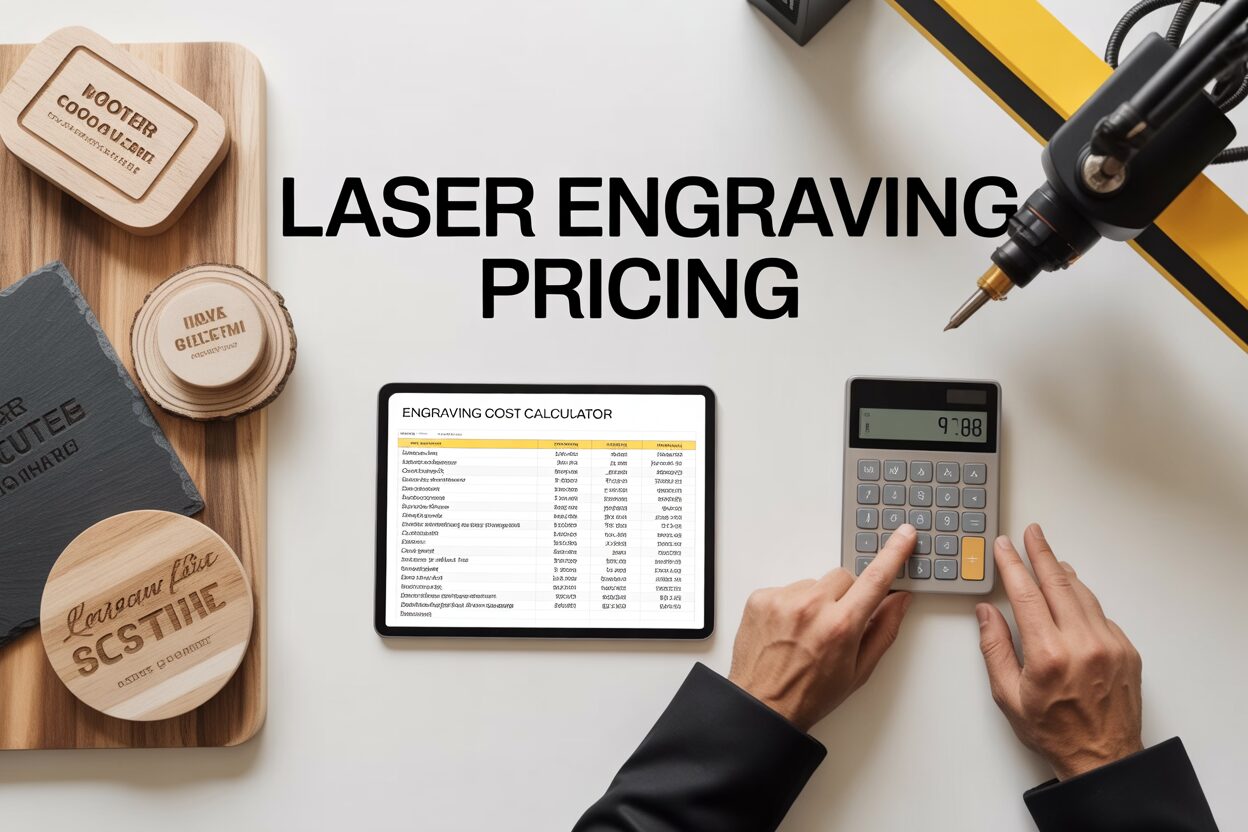
To streamline this process, creating a simple engraving cost calculator in a spreadsheet is highly recommended. Set up columns for each cost variable (material, machine time, labor time, overhead rate, etc.), a cell for your markup multiplier, and a final cell that automatically calculates the price. This tool will allow you to quote jobs quickly and consistently. While the Cost-Plus model provides a logical floor for your pricing, it’s also important to be aware of Value-Based Pricing. This model prices items based on their perceived value to the customer rather than your direct costs. A highly artistic engraving or a personalized memorial item holds far more emotional value than its material cost suggests. For such unique pieces, you can and should price higher than your standard formula dictates. The best strategy is often a hybrid: use the Cost-Plus model to know your absolute minimum price to be profitable, then adjust upward based on the item’s perceived value, complexity, and uniqueness.
Adjusting for Complexity and Market Value
While your core pricing formula provides an essential financial baseline, it doesn’t account for the vast differences between projects. Treating a simple name engraving the same as a complex photo engraving will quickly lead to unprofitable jobs. To truly price for profit, you must learn to adjust your pricing based on project-specific variables, starting with Design Complexity. The labor you calculated in your formula must be flexible. Engraving a stock design or a simple line of text might take only five minutes of setup, justifying your standard labor charge. However, a customer providing a low-quality photo to be engraved onto wood requires significant pre-production work. This can include hours spent editing the image, converting it for engraving using dithering methods, and running multiple small tests on scrap material to perfect the laser settings. For these complex tasks, you should charge a separate design fee or use a higher hourly rate for design services compared to simple machine operation. For instance, you might have a $25/hour rate for basic setup but a $60/hour rate for custom graphic design and photo preparation.
Engraving/Cutting Time
Just as design time varies, so does the physical Engraving/Cutting Time. Your pricing must accurately reflect how long the laser is running. A shallow vector score on a small keychain might take 30 seconds, whereas a deep, high-resolution 3D relief engraving on a piece of thick maple could take several hours. This is precisely why calculating your hourly machine operating cost is so critical. Every minute the laser is firing, it’s consuming electricity, contributing to the wear of the tube and optics, and depreciating in value. Your pricing formula must multiply your machine’s hourly operating rate by the job’s duration. Using a tool like LightBurn’s “Preview” function can give you a surprisingly accurate estimate of the job time before you even begin. By tying price directly to machine time, you ensure that longer, more intensive jobs are proportionally more profitable and that you aren’t losing money on projects that monopolize your machine.
Material Differences and Associated Risk
Furthermore, the material itself introduces pricing nuances beyond its simple cost per square inch. Engraving on a standard piece of birch plywood carries a low risk; if a mistake happens, the material loss is a dollar or two. Engraving a custom message on a client’s expensive leather-bound journal or a one-of-a-kind piece of reclaimed wood is a different story. The risk is significantly higher, as a mistake could require you to replace a costly and unique item. Your pricing should reflect this risk. For customer-supplied items or high-cost materials, it is wise to increase your markup or add a specific “difficult material surcharge.” This premium acts as a form of self-insurance against potential errors. Certain materials may also be harder on your machine, requiring more power, producing more residue that necessitates frequent cleaning, or even releasing fumes that require more robust ventilation. This increased maintenance should also be factored into the price for jobs using such materials.
Finally, your prices do not exist in a vacuum. You must conduct market research to ensure your pricing is competitive and aligned with customer expectations. Spend time on platforms like Etsy, Amazon Handmade, and local online marketplaces. Search for profitable laser engraving products that are similar to what you want to offer. Analyze what your competitors charge for a personalized cutting board, an acrylic wedding sign, or a set of slate coasters. Don’t just look at the final price; consider the size, the perceived quality, and whether they include shipping. The goal is not to be the cheapest. The goal is to find your place in the market. If your calculated price for an item is $40 and the market average is $55, you have identified a profitable niche and have room to increase your markup. Conversely, if your price is significantly higher than the market, you need to analyze why. Are your material costs too high? Is your process inefficient? Understanding the market landscape allows you to position your products effectively, justifying a premium price through superior quality, unique designs, or exceptional customer service.
Conclusions
Effectively setting engraving prices is not about guesswork; it’s a strategic process. By meticulously calculating your costs, applying a reliable pricing formula, and staying informed about the market, you can build a sustainable and thriving business. Use these principles to price your work confidently, ensuring you are compensated for your skill and investment, and turning your craft into a profitable venture.
Frequently Asked Questions
Q: What is the most important first step in pricing my laser engraving work?
A: The most critical first step is to thoroughly calculate all your foundational costs. This includes the cost of your materials (per square inch, including waste), your machine’s hourly operating cost (amortization, maintenance, electricity), and your business overhead costs (rent, software, marketing). Without knowing your true costs, you cannot set a profitable price.
Q: How do I calculate my machine’s hourly operating cost?
A: To calculate your machine’s hourly rate, sum up three key components: 1) Amortization (the machine’s purchase price spread over its expected lifespan), 2) Maintenance & Consumables (like a replacement laser tube, divided by its hourly rating), and 3) Electricity (your machine’s power draw multiplied by your utility rate). This gives you a cost for every hour the laser is running.
Q: What’s a good markup to use for my laser-engraved products?
A: A standard starting markup (keystone pricing) is 2x your total cost (material + labor + overhead). However, for custom, personalized, or artistic items, a markup of 3x, 4x, or even higher is often appropriate. Your markup should cover your profit, taxes, and funds for business reinvestment.
Q: Should I charge extra for complex designs or customer-supplied items?
A: Absolutely. You should charge a separate design fee or use a higher hourly rate for complex work like photo editing and preparation. For customer-supplied or expensive items, add a “difficult material surcharge” or increase your markup to cover the higher risk of error and potential replacement cost.
Subscribe to Our Newsletter
And enjoy FREE Download Files, SALE Alerts and Inspiring TIPS
Pricing Your Laser Engraved Products for Profit
A Comprehensive Guide on How to Price Laser Engraving Jobs
Pricing Your Laser Engraving Work for Profitability
Charcuterie Board Engraving File – Wine & Grapes 3D Illusion…
$4.00Original price was: $4.00.$3.00Current price is: $3.00.(25% off)
Bee and Honey Jar Charcuterie Board Engraving File | PNG Download #007…
$4.00Original price was: $4.00.$3.20Current price is: $3.20.(20% off)
Valentine Love Captions: 6 Charcuterie Board Engraving Files…
$8.00Original price was: $8.00.$5.60Current price is: $5.60.(30% off)
American Eagle Flag Laser Engraving File for Charcuterie & Cutting…
$4.00Original price was: $4.00.$2.80Current price is: $2.80.(30% off)