

 Français
 Deutsch
 Español
 Italiano
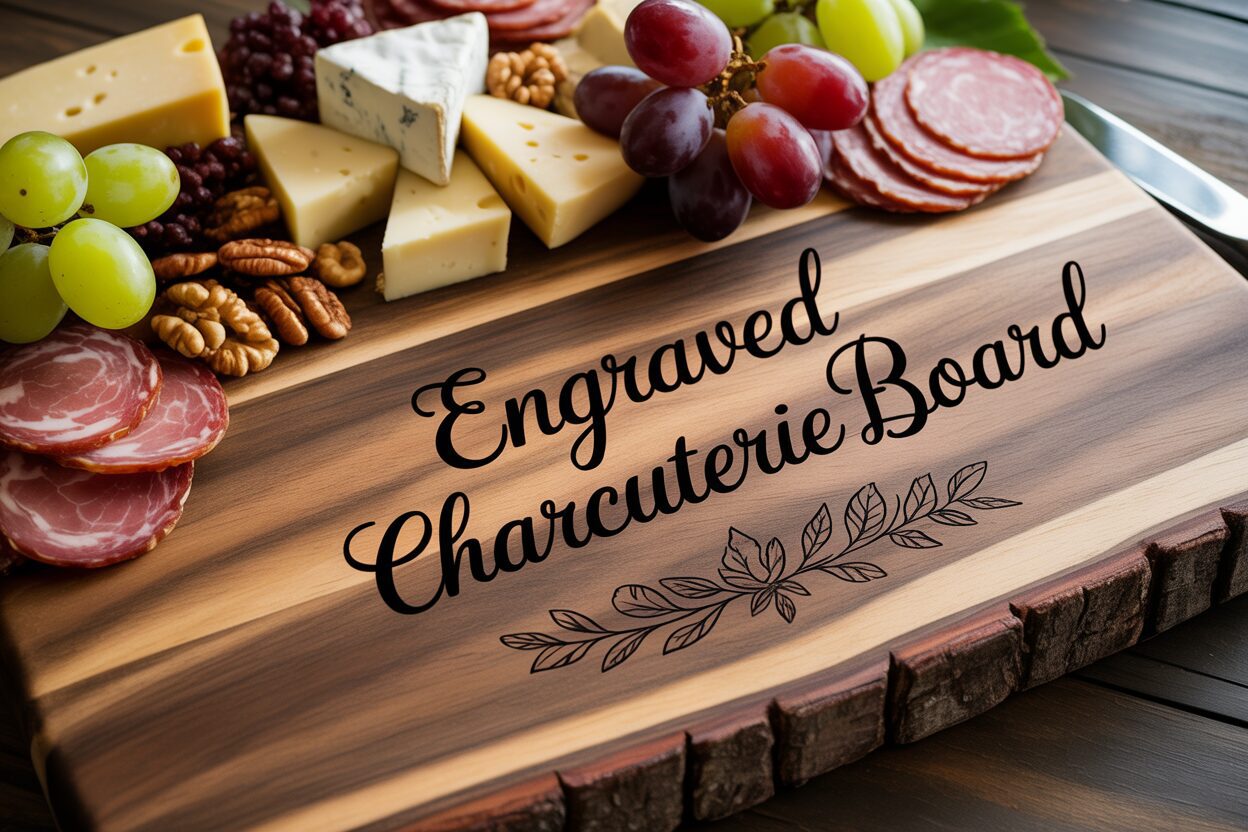
Creating the Perfect Engraved Charcuterie Board
Dec
Estimated reading time: 9 minutes
Key Takeaways
- The choice of material is foundational; hardwoods like olive wood, acacia, and walnut offer distinct aesthetics for engraving, while slate provides a modern, high-contrast alternative.
- Using vector files (like SVG) is non-negotiable for achieving sharp, scalable, and professional-quality engraved designs, as they prevent the pixelation common with raster images (JPEGs).
- Testing laser settings (power and speed) on a scrap piece of the same material is a critical step to achieve the desired depth and darkness of the engraving without ruining your final board.
- The post-engraving finishing process, particularly applying a food-safe mineral oil or board conditioner, is essential for protecting the wood and dramatically enhancing the visual contrast of the design.
- Proper long-term care, including hand-washing only and periodically re-oiling the board, is crucial to maintain its beauty and ensure its longevity as a personalized keepsake.
Table of Contents
- Choosing the Ideal Board for Engraving
- Finding and Preparing Your Engraving Design
- The Laser Engraving Process Step-by-Step
- Finishing and Caring for Your Engraved Board
- Conclusions
- Frequently Asked Questions
Discover the art of creating a beautiful engraved charcuterie board. This guide will walk you through the entire process, from selecting the right materials and designs to the final finishing touches. Learn how to transform a simple wooden or slate board into a personalized masterpiece perfect for gifting or elevating your own home entertaining.
Interested in more Charcuterie Board? Check out our Charcuterie Board laser file designs: Click here!
Choosing the Ideal Board for Engraving
The foundation of a breathtaking engraved charcuterie board is, quite literally, the board itself. Your choice of material acts as the canvas for your art, influencing not only the final aesthetic but also the engraving process and the board’s functionality. Selecting the right material is a critical first step that separates a good result from a truly professional one.
Wood: The Classic Canvas
Wood is the traditional and most popular choice for charcuterie boards, offering warmth, character, and a natural, food-safe surface. However, not all woods are created equal when it comes to laser engraving. The key factors to consider are hardness, grain pattern, and color. Harder woods with tight, closed grains tend to produce cleaner, sharper engravings with less charring.
- Olive Wood: Known for its stunning, dramatic, and often chaotic grain patterns, olive wood creates a one-of-a-kind piece every time. It is a very hard, dense wood that engraves beautifully, producing a rich, dark mark. Its natural oils make it inherently food-safe and resistant to odors and bacteria. The primary drawbacks are its cost and the inconsistency of its grain. The wild patterns, while beautiful, can sometimes interfere with the legibility of very fine or detailed text.
- Acacia: A highly sustainable and popular choice, acacia boasts incredible color variation, ranging from light blonde to deep brown, often within the same piece. It is a durable hardwood that provides excellent contrast when engraved. The laser burn on acacia is typically a deep, rich brown, which stands out well against both the light and dark sections of the wood. Be mindful that this color variance can affect the perceived uniformity of the engraving across the entire design.
- Walnut: For a sophisticated, premium look, walnut is unmatched. Its deep, chocolatey brown color provides a luxurious backdrop for engraving. The laser creates a subtle, darker “tone-on-tone” effect rather than a high-contrast mark. This results in an elegant, understated finish that is highly sought after for high-end gifts. Walnut is a hardwood with a fine, straight grain, making it an ideal surface for intricate designs.
- Bamboo: While technically a grass, bamboo is an eco-friendly and incredibly hard material. Its light, uniform color offers a perfect canvas for high-contrast engravings that really pop. Bamboo is also budget-friendly and widely available. However, its hardness and composition can sometimes lead to more resinous buildup during engraving and the fibrous nature of the grain can occasionally result in a slightly less smooth finish compared to traditional hardwoods.
Slate: The Modern Alternative
For a contemporary and dramatic aesthetic, slate is an excellent choice. This natural stone provides a dark, textured surface that is non-porous and easy to clean. When hit with a laser, the surface of the slate fractures on a microscopic level, producing a permanent, light gray or off-white mark. This creates a striking, high-contrast result that is impossible to achieve with wood. Slate is perfect for minimalist designs, monograms, and modern typography. Its main drawback is its brittleness; it can chip or break if dropped and is not suitable for cutting on. When engraving slate, you’ll typically use lower power and higher speed settings to avoid overheating and causing larger flakes to break off.
Sourcing and Selecting the Perfect Board
Once you’ve decided on a material, the final step is to find a quality board. Look beyond big-box stores and explore woodworking suppliers, specialty kitchen shops, and online marketplaces like Etsy for unique, high-quality pieces. When you have a board in hand, inspect it carefully.
- Thickness: A thicker board feels more substantial and is less likely to warp over time. Aim for a minimum thickness of 0.5 inches (1.3 cm), with 0.75 inches (1.9 cm) being ideal.
- Finish: The best boards for engraving are either unfinished or treated with a simple food-grade mineral oil. Avoid boards with heavy lacquers, varnishes, or epoxy coatings. These finishes can release harmful fumes when lasered and will prevent a clean, deep engraving. You can always apply your own food-safe finish after engraving.
- Construction and Quality: Opt for solid wood over composites. Check that the board is perfectly flat, as a warped board will lead to inconsistent focus and a poor-quality engraving. Finally, examine the surface for any large knots, cracks, or imperfections in the area you plan to engrave, as these will disrupt your design.
Finding and Preparing Your Engraving Design
With your perfect board selected, it’s time to choose the artwork that will transform it from a simple serving piece into a personalized treasure. The design is the soul of the project, and preparing it correctly is crucial for achieving a crisp, professional-looking engraving. The technical foundation of any great laser design is the file type: you must work with vector graphics.
Vectors are Vital for Clean Engraving
Unlike raster images (like JPEGs or PNGs), which are made of pixels and become blurry when enlarged, vector files are created from mathematical paths. This means they can be scaled to any size without losing quality, ensuring your laser follows a perfectly smooth and precise line. For laser engraving, this is non-negotiable. Using a vector file results in sharp edges and clean fills, while a raster file will almost always produce a jagged, pixelated, and unprofessional result. The most common and versatile vector file format you will encounter is SVG (Scalable Vector Graphics), though you may also work with AI (Adobe Illustrator) or DXF files.
Finding and Creating Your Perfect Design
The internet is a treasure trove of design resources for every skill level. For those looking for ready-to-use artwork, online marketplaces like Etsy, Creative Fabrica, and Design Bundles are excellent starting points. Using specific search terms is key to finding what you need quickly. Start with something like ‘charcuterie board svg’ for templates that often include family name placeholders and kitchen-themed graphics. Broaden your search with ‘cutting board engraving files’ or ‘laser designs for chopping boards’ to discover a wider array of wreaths, borders, and intricate patterns.
For a truly one-of-a-kind ‘custom cheese board’, consider creating your own design. Software like Adobe Illustrator, CorelDRAW, or free alternatives like Inkscape allow you to design from scratch. This opens up endless possibilities:
- Monograms and Names: A timeless classic. Experiment with elegant script fonts for initials or bold, modern fonts for a family name and an “established” date.
- Personal Recipes: Digitize a cherished family recipe, perhaps even in a relative’s actual handwriting (which can be traced into a vector format), for a deeply personal and sentimental gift.
- Unique Graphics: Design a custom logo for a housewarming gift, an intricate floral border that matches their home decor, or a whimsical illustration that reflects the recipient’s personality.
- Functional Designs: Engrave designated areas for “Salty,” “Sweet,” and “Savory,” or add subtle lines to guide the arrangement of cheeses and meats.
Scaling and Placement: The Art of Composition
Once you have your design, the final preparation step is to thoughtfully place it on the board. A design should complement the board, not overwhelm it. Open your design software and create a digital outline of your physical board’s exact dimensions. This allows you to virtually place and scale your design for a perfect preview. Consider the board’s shape and grain. A beautiful, swirling grain on an olive wood board might be best complemented by a simple monogram in a corner, while a uniform bamboo board can handle a large, centered design. Common placements include the bottom-right corner, centered along the bottom edge, or perfectly centered in the middle. A helpful real-world tip is to print your design to scale on paper, cut it out, and physically place it on the board to visualize the final look before you ever turn on the laser. This simple step can save you from costly placement mistakes.
The Laser Engraving Process Step-by-Step
With your design finalized and your board ready, you are now prepared to bring your vision to life. This is where the magic happens, but it demands precision, patience, and a strict adherence to safety protocols. Following these steps will guide you through the process of creating a perfectly engraved charcuterie board, from setup to the final pass of the laser.
Step 1: Preparation and Safety First
Before powering on your machine, safety is your top priority. Always wear the safety glasses rated for your specific laser’s wavelength. Ensure your machine’s ventilation system or exhaust fan is running properly to remove smoke and fumes from your workspace. Keep a fire extinguisher rated for electrical fires within easy reach. The most important rule of laser engraving is to never leave the machine unattended while it is operating.
To achieve the cleanest result and minimize smoke staining on the wood’s surface, apply a layer of wide masking tape over the area you plan to engrave. Press it down firmly to eliminate air bubbles. This simple step catches the majority of the smoke residue, which you can simply peel away after the job is complete, revealing a pristine surface around your design.
Step 2: Securing the Board and Setting Focus
Place your board onto the laser bed. If the board is irregularly shaped, like many live-edge olive wood pieces, ensure the specific area to be engraved is as level as possible to the laser head. Use a small bubble level to check. A flat surface is critical for a consistent engraving. Once positioned, secure the board so it cannot shift during the engraving process. Use honeycomb pins, hold-down clamps, or even heavy, flat objects placed on the edges (well outside the laser’s path) to lock it in place.
Next, you must set the focus. The laser beam is cone-shaped, and it is most powerful at its finest point. An out-of-focus laser will produce a weak, blurry mark. Use your machine’s focusing tool—whether it’s a manual acrylic gauge that you place between the laser nozzle and the board, or an automatic sensor—to set the correct distance. Double-check this step; improper focus is one of the most common reasons for a poor-quality engraving.
Step 3: Dialing in Your Settings
Laser settings are a balance between power and speed. Power determines the intensity of the beam, while speed controls how fast the laser head moves. Finding the perfect combination is key.
- Deep Burn: To achieve a dark, deep engrave with a rustic, tactile feel, you will use higher power and a slower speed. This allows the laser to dwell on the material longer, vaporizing more of it.
- Light Touch: For a more subtle, delicate marking, use lower power and a higher speed. This is ideal for elegant designs on dark woods like walnut, where you want a tone-on-tone effect rather than a high-contrast char.
Never guess the settings for your final piece. Always perform a test on a scrap piece of the same material or on an inconspicuous area like the back of the board. Engrave a small test grid with various power and speed combinations to see exactly how the material will react. For wood, a starting point might be 40% power at 150 mm/s. For slate, the approach is different; you want to fracture the surface, not burn it. Start with very low power (15-20%) and high speed (300+ mm/s) to achieve a clean, white mark.
Step 4: Framing and Engraving
Once your settings are programmed, use your laser software’s “frame” or “trace” function. This will move the laser head along the outer boundary of your design with the laser off, showing you exactly where the engraving will occur. Adjust the board’s position as needed until the placement is perfect. Once you are confident, close the lid, double-check that your ventilation is on, and begin the engraving. Stay and supervise the entire process until the job is complete.
Finishing and Caring for Your Engraved Board
The laser has cooled and the scent of engraved wood hangs in the air, but your project is not quite finished. The final steps—cleaning, conditioning, and understanding long-term care—are what elevate your piece from a simple engraved object to a durable, food-safe, and professional-quality work of art. This finishing process is essential for both the beauty and longevity of your board.
Post-Engraving Cleaning
The moment the engraving process ends, your board will be covered in a fine layer of smoke and resin residue. If you used masking tape, gently peel it off; it will remove the majority of this buildup. For any remaining residue, the key is to clean effectively without smudging the dark char into the surrounding wood grain. Lightly dampen a soft, lint-free cloth with isopropyl alcohol and gently wipe down the engraved area and the surface around it. The alcohol evaporates quickly and is highly effective at cutting through the sticky residue without raising the wood grain as much as water would. For slate, a simple wipe with a damp cloth is all that’s needed to remove the stone dust and reveal the crisp, white mark. Be thorough but gentle, especially within the fine details of your design.
Applying a Food-Safe Finish to Make Your Design Pop
This is the most transformative step. Applying a finish not only protects the wood but also dramatically enhances the appearance of the engraving. The oil penetrates the wood fibers, enriching the natural color and creating a deep, lustrous finish. This darkens the raw wood, which in turn increases the visual contrast with the even darker, charred engraving, making your design truly “pop.” It is critical to use a food-safe, non-rancidifying oil. Never use cooking oils like olive or vegetable oil, as they will spoil over time and create an unpleasant odor.
- Food-Grade Mineral Oil: This is the industry standard. It’s inexpensive, readily available, and completely food-safe. Pour a generous amount of oil directly onto the board’s surface. Using a clean cloth, work the oil into the wood, covering the front, back, and all sides. Don’t be shy; the thirsty wood will soak it up. Let the board sit for at least a few hours, or preferably overnight, to allow the oil to penetrate deeply. Afterward, use a new clean cloth to buff off all the excess oil until the board feels smooth, not greasy.
- Board Conditioner: For a superior finish, use a board conditioner that blends mineral oil with a protective wax, like beeswax or carnauba wax. Apply the conditioner in the same way as the oil, but the wax will require a bit more buffing to bring out a soft, satin sheen. This wax adds an extra layer of moisture resistance and creates a silky-smooth tactile finish.
Long-Term Care for Your Personalized Charcuterie Board
A well-made personalized charcuterie board can last a lifetime if cared for properly. Provide these care instructions with your board, especially if it’s a gift, to ensure it stays beautiful for years to come.
- Washing: Hand wash only with mild soap and warm water immediately after use. Never place the board in a dishwasher, as the intense heat and prolonged moisture will cause the wood to warp, split, and crack.
- Drying: Do not let the board soak in water. After washing, dry it immediately with a towel and let it air dry completely, standing on its edge to allow airflow to all sides.
- Re-oiling: The board will need to be reconditioned periodically. A good rule of thumb is to re-apply mineral oil or board conditioner once a month, or whenever the wood starts to look dry or feel chalky. Regular oiling prevents the wood from drying out and maintains its protective barrier.
Conclusions
You now have the knowledge to create a stunning engraved charcuterie board that is both functional and deeply personal. By carefully selecting your materials, using high-quality design files, and following the right finishing procedures, you can craft a beautiful piece that will be cherished for years. Start your next project today and impress everyone with your custom creations.
Frequently Asked Questions
Q: What is the best type of wood for a charcuterie board engraving?
A: Hardwoods with tight, closed grains like Olive Wood, Acacia, and Walnut are best. Olive Wood offers dramatic grain, Acacia provides high contrast, and Walnut gives an elegant, tone-on-tone look. Bamboo is a great eco-friendly and high-contrast option as well.
Q: Can I use a regular image file (like a JPEG) for my design?
A: It is strongly recommended to use vector files (like SVG, AI, or DXF) instead of raster images (JPEG, PNG). Vectors can be scaled without losing quality, resulting in sharp, clean lines, while JPEGs will produce a pixelated and unprofessional engraving.
Q: How do I make the engraving stand out on a wooden board?
A: After cleaning the engraved area, apply a food-safe mineral oil or board conditioner. This enriches the wood’s natural color, making it darker, which dramatically increases the contrast with the even darker engraved design, causing it to “pop.”
Q: Is it safe to serve food on an engraved board?
A: Yes, as long as you finish it correctly. After engraving, clean the board and apply a food-safe finish like mineral oil or a beeswax conditioner. This seals the wood and makes it safe for direct food contact. Always follow proper hand-washing and care instructions.
Subscribe to Our Newsletter
And enjoy FREE Download Files, SALE Alerts and Inspiring TIPS
A Comprehensive Guide to Pricing Your Laser Engraving Services
A Comprehensive Guide on How to Price Laser Engraving Services
How to Price Your Laser Engraving and Cutting Services
Charcuterie Board Engraving File – Wine & Grapes 3D Illusion…
$4.00Original price was: $4.00.$3.00Current price is: $3.00.(25% off)
Bee and Honey Jar Charcuterie Board Engraving File | PNG Download #007…
$4.00Original price was: $4.00.$3.20Current price is: $3.20.(20% off)
Valentine Love Captions: 6 Charcuterie Board Engraving Files…
$8.00Original price was: $8.00.$5.60Current price is: $5.60.(30% off)
American Eagle Flag Laser Engraving File for Charcuterie & Cutting…
$4.00Original price was: $4.00.$2.80Current price is: $2.80.(30% off)